
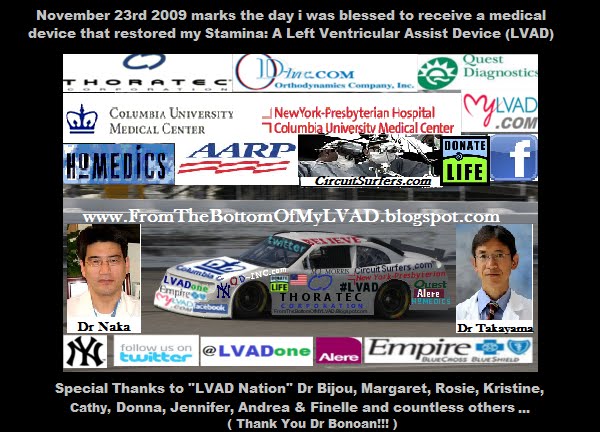
LVAD... Left Ventricular Assist Device

THIS BLOG POWERED BY THE THORATEC HEARTMATE II LVAD:


PARTIAL HEART PUMP = LEFT VENTRICULAR ASSIST DEVICE = LVAD = THE HEARTMATE II


THE LVAD ALLOWED ME to go HOME and conquer my normal and newest tasks once again.


Thank you Columbia-Presbyterian... Dr Naka and his Surgery Team, LVAD Nation, Dr Bijou & Dr Bonoan, Dr Mascitelli and Dr Shulman-Marcus!!!


AND TO THE SCORES OF PHYSICIANS, NURSES, PROFESSIONALS AND PEOPLE THAT PUSHED ME ALONG THE WAY... FORWARD.


Thank You God For I Am Blessed!


If I Was An LVAD-NASCAR Race CAR

If I Was An LVAD-NASCAR Race CAR
I would look like this :-)

FROM THE BOTTOM OF MY LVAD DAILY NEWS AND INFO FEED

Showing posts with label home care. Show all posts

23 April 2010

The Same Veracity, However This Time It Is Titanium!

Let us nuke (microwave) some “No salt” popcorn for 2 minutes… because today is an anniversary of sorts. 5 months this very day since my LVAD surgery. I am feeling monumental …heheheheh. Five months of fighting the good fight for all the expressions & prayers and the medical advances I received or receiving.


Again, I can remember, just a few years ago… in an LVAD-LESS world, I would not be around adding posts to this blog, see my kids and throw my grandchildren playfully onto my shoulders. Grandson One on my right shoulder and Grandson Two on my left shoulder… I begin to charge like a bull, the three of us laugh.

The truth of the matter is, the veracity I have from the Heartmate 2 LVAD has equaled the veracity of life prior to my massive heart attack. I am thankful. In hindsight, getting through these last six months, I applaud myself :-) for the relentless self- discipline used to regain the enjoyment of life’s finer attributes. I respect my vessel… my mind and body.

After all, a leading team of dedicated Medical Professionals, sincerely watch over my health, and for that I know I am blessed with the heavens on my side. Dynamic people doing amazing work at Columbia-New York Presbyterian hospital. As I watch, I have become a patient and a recipient …an amazed spectator.

As the quote goes at the end of the 1st IRON MAN movie…

“I am Iron Man”


Iron Man and Iron Man2 MARVEL.COM The Movie © 2009 © 2010

And the good saga continues…

15 March 2010

The FUTURE PROVIDES THE WIRELESS LVAD/Reducing Infection and Mortality.


2 Informative PDF files explaining the WIRELESS LVAD:

PDF 1:
A Frequency Control Method for Regulating Wireless Power to Implantable Devices

http://www.tetcor.com/A%20freq%20control%20method%20for%20regulaing%20wireless%20power%20to%20implantable%20devices%20(ping%20si).pdf

PDF 2:
Wireless Power Supply for Implantable Biomedical
Device Based on Primary Input Voltage Regulation


http://www.tetcor.com/Ping%20wp%20paper.pdf

LINK:
Brief but interesting info on TRANSCUTANEOUS as opposed to percutaneous lines: Wireless Technology Sparks New Approach to Powering Implantable Devices

http://www.devicelink.com/mpmn/archive/07/03/009.html


SOME BACKGROUND HISTORY ON THE WIRELESS LVAD ORIGINALLY PUBLISHED IN Transitions" 2002, a Penn State College of Medicine publication and the DESIGN NEWS:

Rosenberg Named 2002 Engineer of the Year

Rosenberg has worked on heart-assist pumps since 1970 when he joined the Penn State research team as a graduate student. He earned his B.S., M.S., and Ph.D. degrees in mechanical engineering from Penn State. U.S. clinical trials began for the Rosenberg team’s implanted Left Ventricular Assist Device (LVAD), manufactured by commercial partner Arrow International, Inc., when in February 2001, Penn State’s Walter E. Pae, Jr., successfully implanted the left ventricular assist system for the first in the United States. Called the Arrow LionHeart™, it is the first LVAD powered by wireless electric transmission.

LionHeart TM is intended to help a large population that is ineligible for transplant and for whom medical therapy has failed. Surgeons in Europe have been implanting the device in clinical trials since 1999. Rosenberg said that LVADs represent less risk to patients, both in surgery and later on. "With an LVAD, if there is a component failure, a patient can still rely temporarily on their own heart until the problem is solved," he said, “and because no wires or tubes protrude through the recipient’s skin, the system reduces the chances for serious infection. LionHeart™ is intended to help this much larger population that is ineligible for transplant and for whom medical therapy has failed.” Rosenberg’s team also has an electro-mechanical total artificial heart that is very close in concept to its LVAD.

Rosenberg has found another commercial partner, Abiomed, Danvers, Massachusetts for this device. Abiomed developed AbioCor, a total artificial heart driven by an electro-hydraulic system that Time magazine called the “2001 invention of the year." Abiomed plans to do clinical trials in 2004 of a smaller version of the Penn State heart, suitable for women and children.

Abiomed CEO David Lederman said of Rosenberg, "Gus is one of the primary contributors to this field, and I have tremendous respect for him. We were competitors,but we also have shared a lot of information over the years"

Here is a more recent photo Dr. Rosenberg. He can still be reached at Penn State University.


And the good saga continues...

09 March 2010

"Why were you so quiet? It woke me from my sleep!?"

-------------------------------------------------------------
Perhaps this is a story that words can not do it justice, however i will try because this is Khristine's (from the FAMED "LVAD TEAM" of NYP) favorite story :-)
-------------------------------------------------------------


It's 3am, my wife sleeps peacefully in bed. It has been months since my surgery; having an LVAD implanted and grafted to my heart. One way or another my wife is always by my side watching my back and watching over our household. Its amazing how she also manages her full-time job in her full schedule. And there she rests, after a full day, she is quietly sleeping.


When we sleep, THORATEC sugggests the LVAD's power source should be plugged into the Power Base Unit (PBU) ...while the PBU is plugged into the wall's electrical outlet. In this mode I can walk up to 20-25 feet with the PBU's power cord before i run out of leash.

Should i need to walk further, I must change my power source over to battery. Now 3:05am wanting to walk further into the livingroom, I need to change the power source and will try not to wake her up.


Now its 3:10am and when switching over to battery, the PBU and the System Controller (that is worn around my waist) will launch high pitched alarms to alert me that there is a brief disconnection and a connection is needed quickly.


However, if you can transfer from PBU to battery in less than 5 seconds, no alarms will sound; all remains quiet.


So in an effort not to disturb my wife's sleep, I slowly remove myself from the bed and exchange power sources in under 5 seconds. No blaring and high pitched alarms. She did not wake up :-)

It wasn't until i was walking outside the bedroom, my wife woke up lunging, startled from the "emptiness" of the bed. She Looked at me and quickly said "Why were you so quiet? It woke me from my sleep!?" And here i was trying to avoid the LOUD alarms not to wake her up but found being quiet... she wakes up too.

My wife, My best Friend, the caregiver always has my back!

and the good saga continues...

02 March 2010

The LVAD is a sensible and remarkable option for people with heart falure.

Due to my heart failure my Cardiologist told me i would need a temporary LVAD (left ventricular assist device) to extend my life and lead as normal of a life as possible until my heart transplant. I was classified as a "Bridge to Transplant" patient. Other folks who can not receive a heart transplant may recieve a permanent LVAD under the classification "Destination Therapy".

The LVAD is a titanium pump that does the job of the heart's left ventricle; pumping oxygen enriched blood.

It is implanted behind the ribcage and grafted to the heart.

The pump is a mini jet/turbine motor turning 8,600 +/- revolutions per minute (RPM). Its job is to pump 4 to 7 liters of blood per minute from the left ventricle up to the aorta. The LVAD is powered through a special wire called a driveline that is connected to the pump portion of the LVAD and tracks through the body to an exit point in the lower left or right abdomen.


The driveline wire exits the abdomen and is connected to a system controller/computer that monitors and powers the LVAD. The main functions of the system controller maintain the pump motor's RPM, the amount of blood flow while alerting the LVAD recipient with alarms should something be abnormal or fail. It also stores in depth daily data that can be seen on a home base system monitor or retrieved at the hospital during routine checkups
.


The power source of the LVAD is electricity via a household electrical outlet or 2 lithium batteries. The lithium batteries can last up to 16+ hours in an emergency but 12 hours is the recommended use before changing to fully charged batteries.

Each battery weighs close to 1.5 lbs and worn in shoulder-supported holsters.


When at home, but especially asleep, the batteries are removed and the LVAD is plugged into a household electrical outlet. Each time an LVAD recipient leaves his or her home, they must carry at least 2 extra batteries and an extra system controller in the event of rare problems or failures.

As an LVAD recipient, I believe the LVAD is a sensible and remarkable option for people with heart falure. As stated by a cardiologist at NewYork-Presbyterian Hospital, Dr Ulrich Jorde said "...it could save the lives of 10,000 Americans a year."

And it saved mine.

And the good saga continues...